 Azuro
Azuro connects prediction apps with market data and shared liquidity
Azuro powers decentralized prediction apps with shared liquidity pools on blockchains compatible with the Ethereum Virtual Machine (EVM). Apps provide the interface, data providers supply markets and pricing, and liquidity providers fund the pools behind bets. Each app chooses which supported markets it displays. The protocol uses virtual automated market makers and LiquidityTree accounting to connect these roles. Placing a bet, supplying pool capital, and building an interface are separate ways to participate, with different responsibilities and exposure.
The short version: An app's market selection controls its interface, while a liquidity position follows the markets supported by its chosen pool.
Apps, data providers, and pool capital
Prediction apps connect people to markets whose pricing and funding come from other parts of the protocol. An interface can organize events and present betting options without building a separate pool for every market. This separation lets an app concentrate on how people find and use supported markets, while the underlying contracts handle the betting infrastructure.
A data provider supplies event information and sell-side odds, the terms against which bettors place wagers. Its responsibilities include creating and canceling events, updating prices, and resolving outcomes. Displaying those markets does not make an app their data provider.
Liquidity providers contribute capital to service bets. Bettors take positions on offered outcomes, creating activity from which the supporting pool can earn profits or incur losses. The economic interests differ: a winning bettor receives a payout, while that result can reduce the pool's earnings.
The protocol has no designated canonical app. Different operators can build interfaces connected to its contracts.
vAMMs and the price of an outcome
A condition groups the outcomes of a prediction market, with a virtual automated market maker, or vAMM, providing its pricing mechanism. The data provider allocates reinforcement, the liquidity assigned for pricing, across outcomes and sets a margin. Those allocations establish the initial sell-side odds. Each condition can inherit liquidity from its supporting pool without requiring a separate deposit into that individual market.
Betting activity then changes the vAMM's virtual fund balance and relative odds. A bet on one outcome lowers its offered odds while increasing those of the other outcomes. Prices therefore respond to betting flows as well as provider inputs. An offered probability expresses market pricing; it does not establish the event's eventual result.
LiquidityTree and pool-wide exposure
LiquidityTree accounts for funds within a shared pool and supports the allocation of profits and losses across liquidity positions. Liquidity providers gain exposure to all prediction markets supported by the pool they enter. Pools differ by token and chain, so this exposure concerns the chosen pool. It does not extend automatically to every deployment. The same arrangement lets multiple markets use pooled capital, subject to the pool's capacity, without turning each market into a separately funded liquidity position.
Deposit timing also affects returns. A new position takes loss exposure from markets already open at deposit, while its profit exposure starts with markets created afterward. That asymmetry can produce an initially negative position. Historical pool performance alone cannot explain the return on a deposit made at a different time.
A filtered market and a pool position
In this hypothetical example, two interfaces connect to the same pool. An active condition from that pool appears in one interface, while the other deliberately filters it out. The missing listing reflects the second app's display choice; the condition remains among the pool's supported markets.
A liquidity provider in that pool still has exposure under the pool's accounting rules. Choosing the interface with the shorter listing does not narrow that exposure. If the condition belongs to a different pool, that exposure conclusion no longer follows.
How does a signed bet become an onchain position?
In the relayer-based betting flow, an executor places the bet onchain after the bettor and oracle sign its data. Token-spending approval first authorizes the Relayer contract to use the bet asset. The bettor signs the parameters using EIP-712, a structured-data signing standard, and sends them through the API. The oracle adds its signature, and the executor submits the orders to the contract.
Successful execution emits the NewLiveBet event and issues an AzuroBet token. A wallet signature alone does not establish a placed bet.
Interfaces and developer tools
AzuroSDK supplies web components for applications connected to the protocol, including interfaces beyond conventional betting screens. Viewer interfaces can present event probabilities and other market information. Apps can also take the form of widgets, integrations, or standalone products. Developers can localize an interface or specialize its market selection while using the underlying infrastructure.
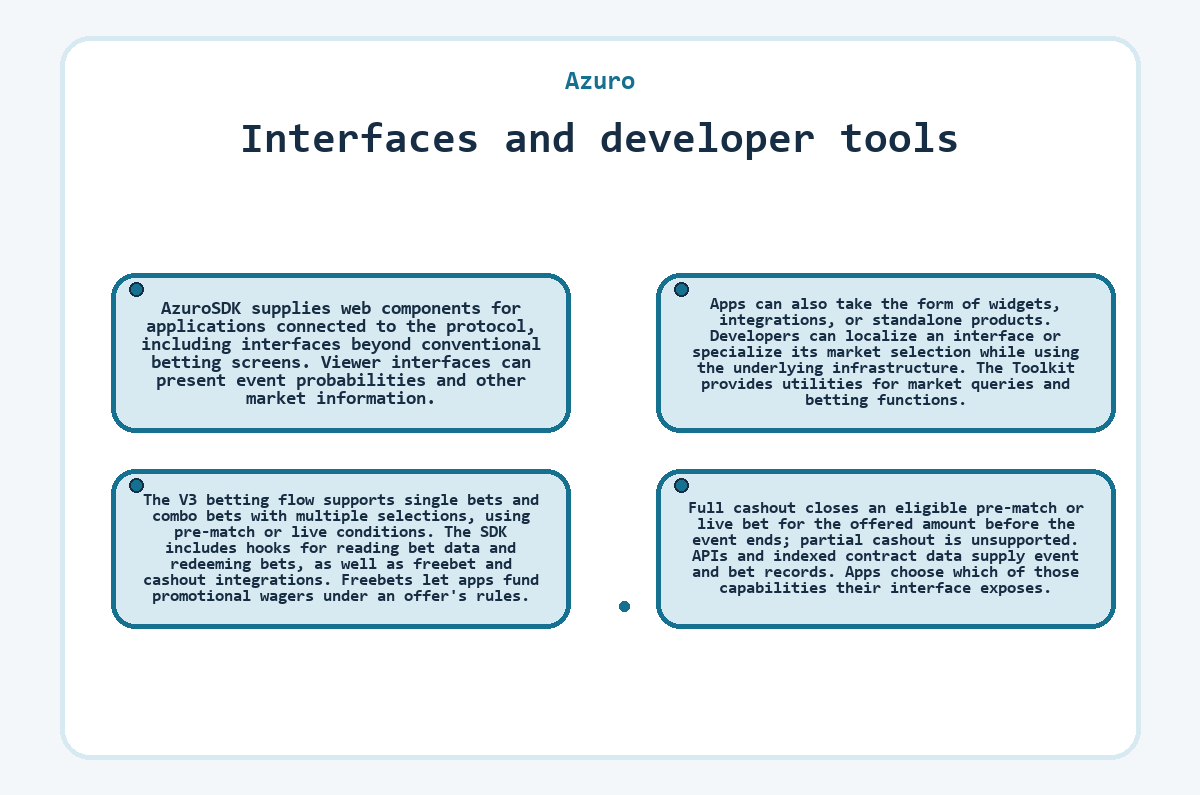
The Toolkit provides utilities for market queries and betting functions. The V3 betting flow supports single bets and combo bets with multiple selections, using pre-match or live conditions. The SDK includes hooks for reading bet data and redeeming bets, as well as freebet and cashout integrations. Freebets let apps fund promotional wagers under an offer's rules. Full cashout closes an eligible pre-match or live bet for the offered amount before the event ends; partial cashout is unsupported. APIs and indexed contract data supply event and bet records. Apps choose which of those capabilities their interface exposes.
How do apps earn protocol revenue?
Apps receive a revenue share tied to betting activity attributed to their addresses, subject to the app-reward calculation. The monthly app-reward calculation applies separately to each chain. An app's reward is the lower of its RevenueReward and SpreadRewardCap for that month. RevenueReward equals 70% of protocol revenue attributed to the app. SpreadRewardCap sums 50% of each bet's margin multiplied by its wager amount across that month. AzuroDAO can change these rates.
Corrected outcomes following a data-provider error can change the final reward calculation. App rewards can be positive or zero, while pool losses can make liquidity-provider, data-provider, and DAO rewards negative. An app's reward and a bettor's payout therefore describe different amounts, with different recipients and calculation rules.
AZUR, stAZUR, and pAZUR
AZUR is the protocol's ERC-20 token, with a total supply of 1,000,000,000 tokens. Token ownership, token staking, and supplying capital to a prediction pool are distinct forms of participation. A pool's betting asset follows that pool's configuration; the AZUR ticker does not identify every pool's asset.
Staking AZUR produces stAZUR, a non-rebasing liquid staking token representing the stake and accrued rewards. Rewards accrue in its underlying value without increasing the stAZUR unit balance. Rewards depend on protocol activity and the applicable campaign.
pAZUR adds a different commitment: an ERC-721 non-fungible token (NFT) backed by stAZUR locked for a fixed, non-cancellable two-year period. This mechanism operates only on Ethereum and requires Ethereum-origin stAZUR; Base is unsupported. When protocol revenue funds distributions, active pAZUR NFTs receive proportional USDT allocations based on their locked stAZUR amounts. Holders can claim accrued distributions, and economic rights follow the transferable NFT. Distributions depend on protocol revenue, with no fixed APR. Transferring the NFT changes who holds those rights; it does not remove the underlying lock.
Who resolves an event result?
The data provider resolves the event, with AzuroDAO acting as the arbiter of last resort when a resolution is disputed. An event ending does not itself record winning outcomes in the contracts. Settlement supplies the outcome the payout mechanism uses. AzuroDAO also has a governance role in selecting qualified data providers. That role concerns the protocol's operation, separate from the choices an app makes about its layout or market selection.
Wallet custody and payout rights
A noncustodial interface connects betting activity to smart contracts without requiring a conventional custodial app balance. Wagered funds interact with those contracts, so self-custody does not mean every committed token remains spendable in the wallet during an open bet. Custodial apps use a different arrangement. The way an app manages keys and funds determines the relevant custody relationship.
For a winning bet funded without freebets, the payout goes to the bet token's owner through the pool's payout function. Freebet-funded bets use a separate PayMaster withdrawal path. Their payout treatment follows the freebet's rules, so a promotional amount and the bettor's eventual proceeds need not match.
Networks and permissions
Production V3 deployments include Polygon, Gnosis, Base, and Chiliz, with contracts and betting assets specific to each deployment. EVM compatibility describes the underlying execution environment; an app needs an actual supported deployment to offer those markets. A network appearing in the protocol's deployment set does not establish that every app exposes it, or that every software feature has identical support there.
Permissionless app development and liquidity provision also differ from supplying the protocol's event data. Data providers remain permissioned because their pricing and settlement responsibilities affect the pool. An application's availability additionally reflects its own operations and applicable jurisdiction. Access through one interface therefore cannot establish the eligibility, custody model, or supported features of another.
Common questions, answered
Can a new liquidity position be withdrawn immediately?
New liquidity positions have an initial seven-day lock before withdrawals become available. Expiry of that period does not establish that a deposit has recovered any losses, since returns depend on the performance of the markets the pool supports.
Does gasless betting remove every cost of a wager?
Gasless betting means a supported app can place the bet without requiring the bettor to hold the network's gas token. The wager still uses its betting asset, and quoted odds include the applicable margin. Implementation differs by app. Social login alone does not establish gasless support.
What changed in the displayed freebet payout with SDK v8.2?
SDK v8.2 changed the payout and settledPayout fields for freebets returned by useBets to show the bettor's share under the freebet contract's rules. The October 10, 2026 release pairs that SDK with Toolkit v7.2. Earlier SDK versions showed the pool's whole payout in those fields. The useLegacyBets hook retains V2 figures. An interface that previously subtracted a returnable freebet's stake must avoid subtracting it again from the newer figures.
Do I need to stake AZUR separately before creating pAZUR?
The pAZUR interface handles staking AZUR and locking the resulting stAZUR in one user flow, so separate manual staking is unnecessary. The route requires Ethereum and creates a fixed, non-cancellable two-year lock. Transferring the NFT moves its economic rights to the current holder without ending the lock.
Which inputs determine a pool's displayed annualized yield?
A pool's displayed yield reflects its historical performance and supplied liquidity. The daily-return calculation divides rewards from events resolved that day by the pool's liquidity at the day's end, then annualizes the result. A higher historical figure does not establish a fixed rate for a new position, whose entry time and exposure differ.